
Service scope
Click one to see its vendors.
Vendors & Technology Leaders
Kedai Tekno’s official partners and the technology leaders in this segment.







For this category, contact us — brand options are tailored to your needs.
Cloud Migration
Cloud migration is the planned movement of applications, data, and workloads from on-premise servers to the cloud — phased, measured, and always reversible.
Why companies need it
Cloud brings scalability and pay-as-you-grow economics — but unplanned migrations end in downtime, cost overruns, and underperforming applications. The right roadmap decides the outcome.
Key benefits
- Costs follow usage: capacity scales up and down without buying new hardware.
- Remote/hybrid ready: applications are securely reachable from anywhere.
- Greater resilience: cloud infrastructure provides redundancy that is costly to build yourself.
Technical examples
- Workload assessment and application dependency mapping.
- Phased migration (rehost/replatform) with low-disruption cut-over windows.
- Post-migration cloud governance and cost optimization.
Example deployment topology
Virtualization
Virtualization splits one physical server into many isolated virtual machines (VMs) — all managed centrally from a single console.
Why companies need it
Virtualization consolidates many physical servers into few — cutting hardware and power costs, speeding up provisioning, and enabling high availability and disaster recovery.
Key benefits
- Hardware and power costs drop: dozens of physical servers consolidate into a few hosts.
- Minutes-long provisioning: new servers spin up from templates instead of waiting on purchases.
- Zero-downtime maintenance: VMs live-migrate between hosts during servicing.
Technical examples
- Virtualization clusters with HA and live migration across hosts.
- VM templates and provisioning automation — new workloads in minutes.
- Periodic capacity reviews and rightsizing for efficient resources.
Example deployment topology
Data Center & Networking
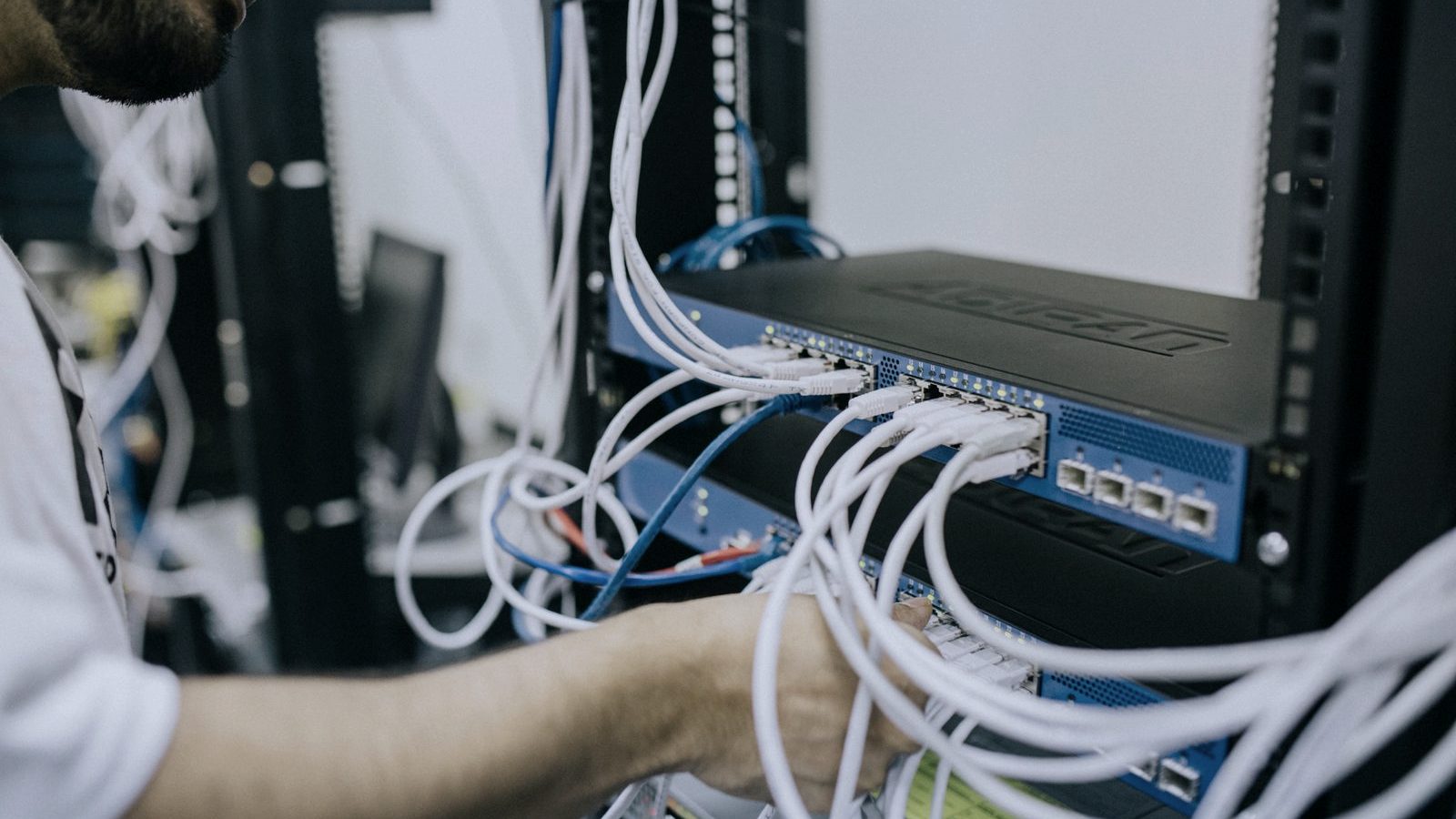
A data center network is the core fabric — core, access, and structured cabling — linking servers, storage, and users; designed redundantly so there is no single point of failure.
Why companies need it
The data center network is the foundation of every digital service. Poor design creates single points of failure and bottlenecks felt across all applications — from ERP to email.
Key benefits
- Apps feel fast: network bottlenecks are removed with proper capacity design.
- Failures go unnoticed: dual paths and devices keep one component failure from stopping service.
- Easy growth: a tidy, documented topology makes adding racks or services plug-in work.
Technical examples
- Redundant network design (dual uplinks, dual power) with no single point of failure.
- Segmentation and QoS to prioritize critical applications.
- End-to-end monitoring and telemetry for early fault detection.
Example deployment topology
What we do
- Cloud readiness assessment and migration planning.
- Workload migration to cloud or hybrid environments.
- Server virtualization and data center network design.
- Post-migration optimization and documentation.
Let’s discuss your Cloud Network needs
Tell us your situation and goals — our team replies within 1×24 hours on business days, starting with a free brief assessment.
Other service pillars
Cyber Security
Layered protection for your applications, network, email, and users — designed around your business risk profile.
Data Management
Keeping data safe, available, and well-managed — backup, archiving, object storage, and cloud & data protection.
Internet of Things
Always-on digital and operational solutions — digital signage, managed services, and fault-tolerant systems.
IT Infrastructure
A reliable IT foundation on your premises — on-premise servers, storage, and networking.
Artificial Intelligence
From readiness assessment to implementation — intelligent assistants, visual analytics, document automation, and secure AI infrastructure in your own environment.